~ Estimated Reading Time: 14 minutes ~
It's been a while since I've played something with such a legacied history trailing behind it. As contemporary video games reach their middle ages, it feels like we should have a dozen things coming out every year that are directly contending and responding with as much as Donkey Kong Bananza is. But unfortunately Nintendo is one of few, and I choose to see Rareware being laid off just a few weeks before Bananza's release as proof we take these things for granted.

Video games are old now. Donkey Kong Bananza is being positioned as the new generation's first drop from the illustrious 3D Mario Team, but it's more distant from the rest of its family tree than I expected. Surely some Ship of Thesius-ing has been going on with time - Odyssey's director has already moved behind in position like an elder. And Donkey Kong was largely a far-away franchise from Nintendo themselves, outsourced to non-Japanese studios since 1994. Almost like a fangame, there is so little direct DNA of previous projects involved, yet there is an unambiguously strong pull from the past going on. That naturally creates a coolly uncanny feeling of how established artistic cliches will necessarily bend towards the styles of new artists, ones with their own look. When I got to the Tempest Layer, I noticed the N64-iness of the lighting, but like that contextual gap assured that it couldn't look or feel exactly the same. Sometimes it had been prettied up, and sometimes it replicated the exact gaudiness of a mid-budget 3D platformer that didn't even know it was going to be important. Basically, what I'm getting at is that the amount of exchanges of hands generations and continents apart that were required to make this is a miracle. And that resulting surreality comes alive when the 100+ million dollar budgeted AAA game still has the stupid fucking rareware puzzle pieces with googly eyes.

In anticipation, I ended up giving Mario Odyssey a revisit - a game that reignited my interest in platformers at its release; I still hold a good bit of it in high regards. But my feelings have softened over the years. It's conflicted between new and old genre sensibilities. Just as much as the standard running and jumping, it's tried to implement some action-adventure curiosities to it; there's a whole lot of kicking around rocks and ground pounding a shiny part of the floor. Lots of "can you spot it?" that, with the sheer excessive amount of mundanities you'll perform in a short time, becomes forgettable. Mario's movement is also powerful, in the sense that much of its obstacle courses can be leapt over. Once you've gotten used to its "jump, cap toss, dive into cap, jump and dive again" bread n' butter, the initial intrigue of skipping things starts feeling a bit one-dimensional. I don't think it's a game that has rewarded my love for it; returning to it after obsessing over it, it sometimes feels like my muscle memory of a single action plays the whole thing for me.
And here we are. Eight years later, I've got the most direct follow-up I'll ever get for it. Can it improve on my personal gripes; are these gripes even things Nintendo sees as flaws?
And once again, what pulled through was Reconsideration.
Completely swapping out the protagonist has offered much opportunity to retool what made its predecessor tick. Where the secret-searching ended up being a low-point to Odyssey, making a sequel about punching through walls is such a neat way to turn mundane observations into big swings of exploration. Those tiny visual cues, curious pokes out of the ground, and vague points of interest end up taking you on journeys within them, able to create a seamless flow of one observation taking you on a genuine adventure. And while the way Mario interacted with his surroundings was simplistic, I found that I was constantly rotating my entire toolkit to move through levels here. Donkey Kong is full of these synergetic actions, where you're no longer just interacting with your environment, but now seamlessly transforming it into your literal tools. It's great stuff!

There's tasteful influence from modern Exploration games. The multi-hour process of digging, obtaining resources, then melting them into tools in Minecraft has been compartmentalized into about three seconds of grabbing a material, smashing it into another, and seeing how the two clash. Thinning this down to a briskness has enabled recontextualization of more methodical mechanics to uniquely match the pacing of an action game. There is simply a playful physicality to it I haven't seen elsewhere. When you're dealing with a slippery ice or dirt-floor, you can rip the floor out from beneath you to reveal another layer of texture. And I think the real reason I'll end up more charitable to this than Odyssey in the long-term, is that it truly feels like a New Nintendo Game. I don't necessarily mean a new genre or new idea, just...a new game. It's hard to make something new by feeding the machine the past. And when's the last time it felt like one of their games was genuinely cutting edge in a "couldn't do that last console gen" sorta way?
A story I keep hearing is that when people first booted the game up, they just punched through the walls for like twenty minutes straight. And when you enter the first real world - the Lagoon Layer - there is this immediate freedom to pry and tear through the level, to stumble from above onto a Star Shine Moon Banana incidentally, and noticing the actual path afterwards. What I appreciated is how each layer progressively coats important structures with more unbreakable material, as if to ween the player off from relying on flows of mindless digging. In order to build around such utterly strong tools, there needs to be things that Challenge the player, regardless of if this translates to the difficulty being hard. Challenging the mental thought process of digging simply focuses where and when you'll think digging is a good idea. Bananza was at its best when it walked a fine line between that form of Challenge and Imagination; when the player, who has been told not to dig just anywhere, will explore with a certain inquisitiveness. It's idyllically Nintendo when there's that cerebral draw, like lifting a rock on a forest-bed to see a bunch of little worms.
Though...I've been starting to feel as if there is something monotonous about reaching the end of a tunnel, just to find the same Banana in a mundane box at the core of the puzzle. For a topical comparison: in Hollow Knight: Silksong, your path might end in an upgrade, tool, badge, money, or something or someone completely unique. You went in for treasure, and found conversation - that's memorable, that's human. I think there is something sortaaaa imagination crushing about knowing that no matter what I'm doing, I'll always be greeted with that same archetypal reward. Nintendo's infrastructure doesn't seem to have room for much more, which may be a consequence of AAA productions requiring formalizing for its hundreds of devs to stay on the same page. I felt the same way exploring Tears of the Kingdom's caves, with their "always 1 Frog and 1 Treasure Chest" completion checkmarks.
On the bright side, Nintendo has noticed how limiting only having moons and purple coins must've been - and the three-tier of coin is a good compromise. Having each level have one big special thing does a good job to breathe distinct points of memorability. Big fan of the New Nintendo Game Whales recently, cuz the initially inaccessible giant skeleton of one in the first world is very charming. And when I was able to start a second save file, and use my more developed skills to immediately just jump onto the platform without clearing the traditional conditions to unlock a path to it...wow, that sure is video games©!!

It's also the Mario team's first chance to respond to the Zelda team's innovations. Since 2017, Nintendo's only become increasingly confident in their structure of "simple main objective, with challenge spread across optional segments". Bananza is the logical extreme of these ideas: "don't want to do something? Punch through it".
You could say that Cheating has always been a core part Nintendo's style. Since the original Super Mario Bros. - they've built around using Skill to Skip. Almost every single level could technically be cleared using only the jump button, but intelligent use of momentum - your jump getting more height when you run long enough to build speed - meant that you could leap over large chunks of the obstacle course. More literally, Miyamoto stated that glitches would often become features because of his close relationship to his programmers; he could look over their shoulder, and say "this is cool, keep it" when an exploit showed up. There's a dozen examples, like Pokemon Red and Green's success in Japan being credited to the hysteria around finding Mew, or Wavedashing in Melee intentionally not being removed. Breath of the Wild famously blended this ethos with an undercurrent of micro-physics mechanics, so that any player could cheat their way through a puzzle with their knowledge of physics minutia.
And finally with Bananza, the suggestion in the phrase "level design is a suggestion" has become a whimper that won't reach your ears. I feel, well, mixed about this. Because its level design is very neat, and I actually enjoy doing what I've been told to this time around. Sometimes, I'd accidentally bypass something - only to look at the real obstacle sitting behind me, and jump down to play it traditionally. That isn't to say there's no joy in its toybox physics; there's a lot joy in pushing DK's toolset to its limit, but I'm trying to have my cake and eat it too here!

There's this boss fight in the Forest Layer, where a giant flower monster creates a web of voxelized vines that stretch across the entire map. It's a massive technological achievement right in front of you - having these living platforms dynamically wriggle around such a wide space as to create a constantly moving platforming gauntlet. Even while I'm critiquing Bananza, I can't downplay that its programmers are cracked. But honestly, I was struggling to mentally intake how cool the set-piece in front of me was, because I used the Ostrich transformation, and flew right over the vines. My friend said to me not to glide for the final phase, and I'm not saying the boss suddenly went from easy to hard, but... I comprehended the wonder, because I was running directly on top it. In the long-term, what these games will lose out on by never saying no to the player isn't just "difficulty", it's Memories.
~ (Note: while this review is spoiler-free, the video clips I will begin to link will contain spoilers for unrevealed transformations and locations. You don't need to click on anything to understand the core writing, though.) ~
I began to draw a line between when I was doing cheating on the level of tasteful save stating, versus pulling out the whole gameshark. And the titular Bananza transformations tend to be the biggest offenders. It stuck out to me from the beginning how DK:B's world serves as its mechanical economy. By the end-game, there are some genuinely very inspired ways this can come together, like how the only material to break a chunk of Concrete nearby may be a Bomb-rock that an enemy is holding as a weapon. But you can just smash through concrete with Kong Bananza, after all. A quote from a friend that stuck with me was that "the transformations feel like they were added after internal testers thought the game was getting boring".
Everything's been elegantly structured so that you never need these powers, due to you technically not always having access to them - which results in good level design that I felt like I was missing out on if I used them too much. But that makes the feature opt-in by nature - meaning equally that if you aren't enjoying it, you don't necessarily have to use it. And once I found my own way to have fun - simply using basic Donkey Kong - I began to enjoy myself, a lot even! Especially when you hit the late-game, and the Layers more often begin to require of you a transformation, using Donkey Kong's already strong skillset to clear goals that expected a transformation of you, but without one. It's a reminder of just how interesting the default DK moves-list is.
There's just no denying it: genericism is creeping into Nintendo's structural palette. Power-ups were once a key part of SMB1's distinct ethos; levels never required Fire Flowers, and by erasing enemies served as a tool to nullify a portion of the level design - but you gained them by not getting hit, and kept it by not getting hit. 3D Mario would also take strides in the more traditional sequences of being given a power-up as a gimmick that lasts for a segment built around that gimmick, which I'm chill with. But the choice for Bananza Forms to be tied to a passively-refilling cooldown meter makes whether you have access to them or not superfluous. And there's almost no sections similar to Mario Galaxy, where you had to manage time against your limited access. And I'd love to pretend this cynicism ends there, but we've all noticed those 1.5% fire resistance equipment already. We got Skill Trees with no Branches, it's all here.
The last thing I want to nag about is the Open World Game Sonar™. I do understand that in a game where you can break anything, you need to give your players some reassurance that they aren't skipping over dozens of completion% rewards... Once again, I can't think of a better solution than its presence, but that's why I'm not a designer at Nintendo. It's awkward - coming from the IP holders for childhood wonder and Discovery - that more than often am I not finding things with my eyes or senses, but being directed towards them. It's that sort of incidental, hands-off process that makes Memories turn to Mush. There's a lot of unnecessary bandaging holding together Bananza - similar to how Echoes of Wisdom had a "make the game normal where you use a sword" emergency button for whenever its experimental combat stopped working. For what it's worth, this game is also for little kids. And when Nintendo didn't implement optional solve-it features like this, they made games that were significantly more boring for weird gamer adults than this one was.

And because of the nature of the game, Speedruns naturally came to mind. They're the culmination of pushing to the limit - or to say to play at a level where cheating becomes necessary. But - and I don't mean to sound like the "in a petersonian sense" guy - I do think there's a line in which a speedrun begins to skip so much, that it stops being about expressing high-level skill. It's important to say that doesn't have to be a bad thing! There's an art to breaking a game until there's nothing less - that it took decades of collaborative discovery to tear out so much of Ocarina of Time's stuffing so that only 5 minutes of its run-time are left. That sorta thing is obviously beautiful. So, what does that mean for Bananza - a game where breaking it in half is the default means of play? There surely are a dozen cool tricks, but when I pull up actual speedrun footage, and they're soaring over huge chunks of level design with Ostrich... It doubles back to having mundane skips.

But there is something undeniably unique about Bananza's position as a Speedrun By Default game. I'm seeing people who don't often play platformers casually post clips of them tearing the game in half, and there's something obviously cool about it making the appeal accessible. It's the type of game that'd make a child fall in love with game design for the first time, if that makes sense. Which is, obviously, extremely important! I just wonder how many kids would experience what Mario Odyssey was for me - where it made me passionate about its genre, but I also eventually felt the need to 'graduate' from it. While playing these new Nintendo games, I often wonder if it's actually good for children to be mandatorily challenged so little, when helping them Learn and Grow as a result is such a beautiful things games are capable of doing.
And as someone who has sorta desensitized myself to the ultra-polished, perfectly-controlling way Nintendo makes games, the real question on my mind is "what am I getting out of playing these?". What I didn't get to say about Mario Odyssey earlier was my true least favourite part of playing it; it fails to provide me with new things to learn. I tend to look for inspiration in the games I play, and its specific wavelength of Nintendo spectacle can only tell me "well I'd do that too, if I had a budget of infinite money". Which makes sense, I've been playing Nintendo games for my whole life, and I'm already intimately aware of their more universally applicable techniques. This is of course personal, you could even describe it as an overplaying thing. And I think Bananza has diminishing returns as well, even for every shining moment of brilliance.
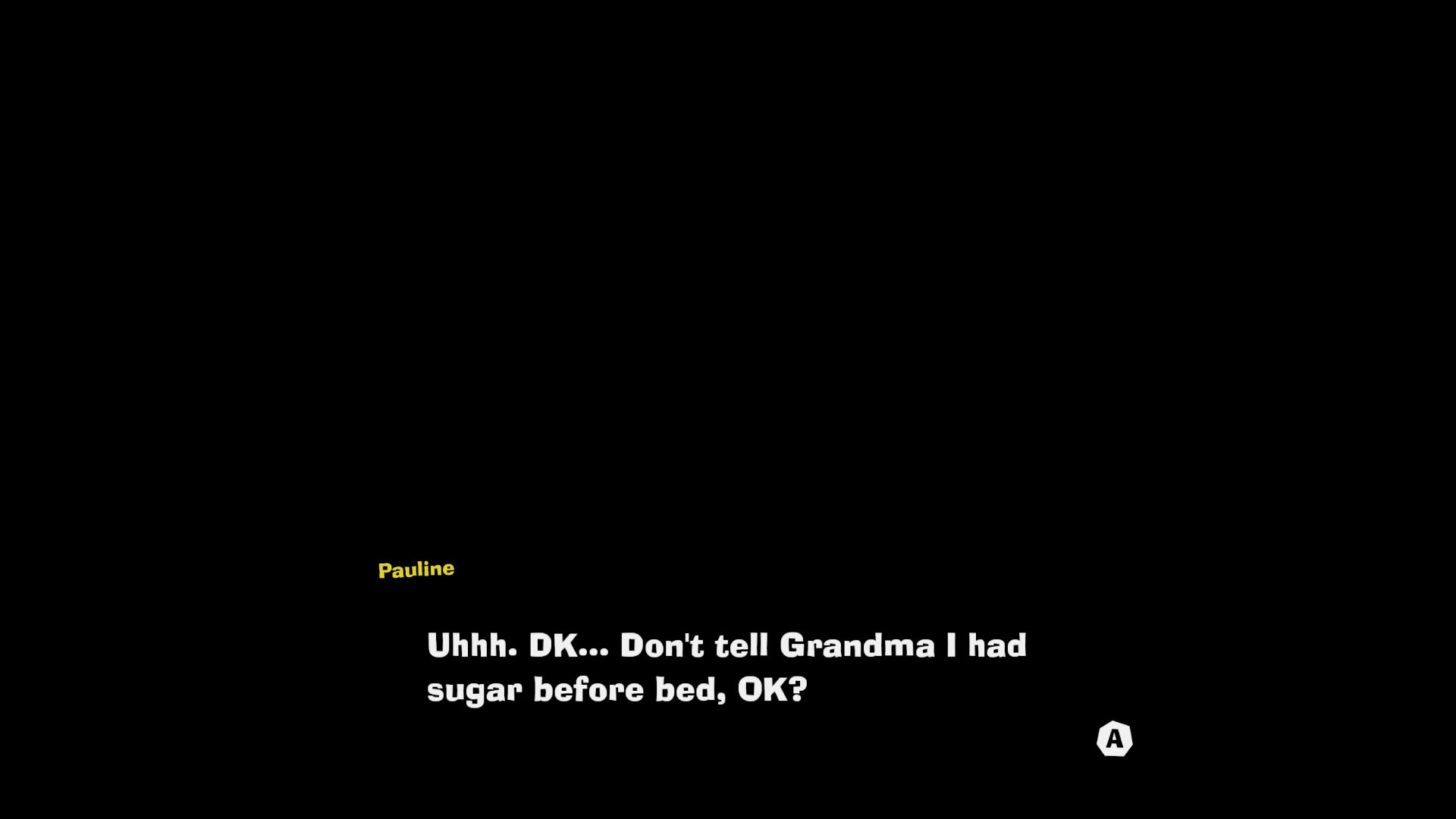
Feels like Nintendo is on the verge of making a New Video Game, while also narrowly skirting around making the most generic thing on earth. Or to phrase it in a less mean way - Donkey Kong Bananza is a genuinely unique experience that feels a bit afraid that it is going to tear in half. I found my experience with the new Mario Kart to overlap with this one - its frustration-proofing getting in the way of truly loving it. But in contrast to that game's under-confidence; with Bananza, it's more like tremendous conceptual weight only occasionally hitting me. And I think if its team could just unchain themselves a bit, this could be something I really love. It shines in moments, after all. I also wonder if it's irresponsible of me; endorsing the 500 dollar investment console as a "messy but good" thing. So I'll end off on saying that I think I'll love the indie games coming out in a half-decade made by people who got their hands on this.