Spoilers!
~ Estimated Reading Time: 7 min ~
I've always had a fear of a lack of control.
To some extent am I referring to the abstract meaning of the word, but also quite literally. In a bodily sense, It is a fear that's come natural to me since the day I was born. I've worked my way through muscle disorder, hand-eye coordination and focus training - and while never quite intensive to need assistance, it did take me some years to get through. Moving my ligaments doesn't come natural to me, and I don't have memories of a time where my hands weren't shaky. This isn't necessarily a sad story to me; as of now at least, I'm the most fit and functional I've ever been + I personally know many who had it much worse than me. But now, when I look back on my rougher years, it feels appropriate to use dreams as an analogue; that imprecise floatiness through a vague space isn't dissimilar to how my brain remembers childhood. And just as naturally do my nightmares often play into this primordial feeling: unable to move as fast as I want to or how I want to. Running away from something and slipping and sliding through hallways that stretch longer than I expected, architecture made just to impede me. I often feel as if I've overcome my past, properly moved on from it mentally. So I guess it's fitting that the world of sleep is where it always returns to haunt me.
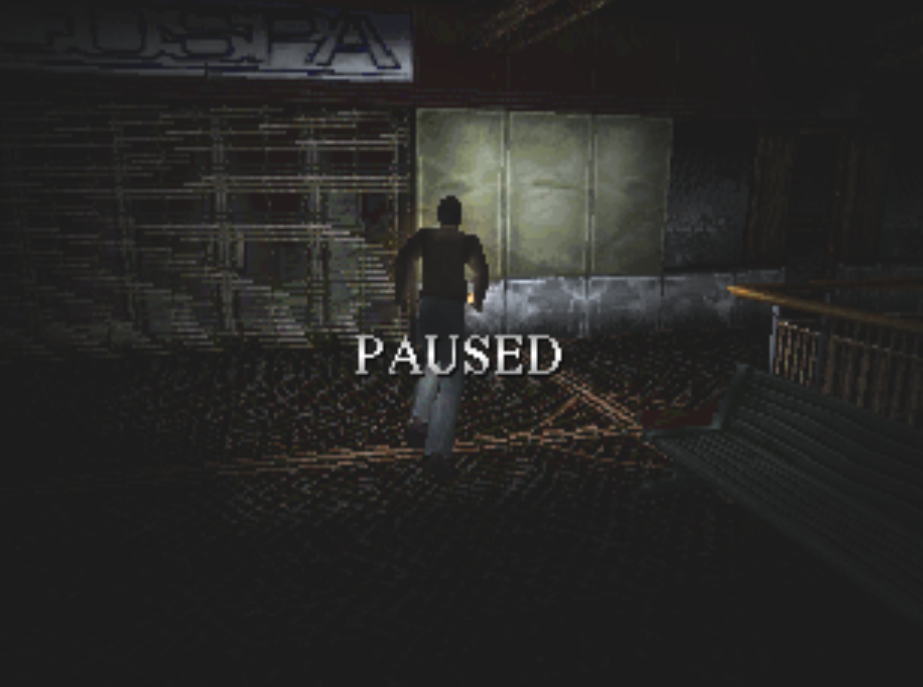
Another set of memories that sends to slip into this throughline is of course controlling video games. They take us to another world, force us to learn and comprehend new means of moving through space. The early 3D physics I grew up with often had an awkward set of weight, gravity pushing against you in ways that took a while to get used to. Each new set of physics like being born into a new, unfamiliar world for you to learn how to take your first steps in. I still to this day remember trying to kill my friend while they had put the controller down and gone to the bathroom during a match of Super Smash Bros. Melee, only to accidentally fall into a pit and die.
I think Silent Hill has a strong understanding of the relation between dreams, and playing a video game. It's only natural that I resonated with the control-scheme of old horror games quite a bit, because, well...you could say I've grown accustomed to having to learn how to move. I'm not positing that I like bad controls; I admittedly haven't struggled much with tank controls since I got obsessed with God Hand as a teenager. It's perfectly consistent - there is just something abstractly human to its natural weak-points. Harry Mason can't just shift trajectories on a dime, you have to think several steps ahead if you don't want to get hurt. And so it preys on those grating repetitions, waiting for you to let your guard down as you get lost in the identical rows of maze-like suburbs. The sluggishness of hitting a turn a second late, only for some frog-zombie-thing to graze your leg. It becomes a mundane, unfeeling process to weather small hits, watching my med kits slowly fade away. The amount of times I've seen from lightyears away I'm about to take damage, and known there's nothing I can do to avoid it; now that's horror.
And Silent Hill is all about Control, isn't it?
From the get-go do we have our protagonist walking around, asking people if they saw where he had left his daughter, like she's a possession, a lost wallet left in an airport. I don't think Silent Hill is portraying Harry in some uniquely negative light - simply a father being stoically protective of his daughter - but ownership begets control. Children are the property of adults, and we just have to be hopeful they're the type to water their garden more than once a day. How well they treat you is simply the luck of the draw. It is a story about a relatively well-adjusted father, and a manipulative mother both attempting to seize the light of Cheryl, so her natural response is to run away from both, and eventually, reality. I've been rotating it in my mind quite a bit, and I think it leaves me with a decent bit to chew on - it'd be easy to position it as a supernatural custody battle of sorts. The dynamic of a young girl having the ground she steps on tugged around, constantly changed against her volition. And I think to myself: what does that mean for Silent Hill, as a storyline of a father being given a taste of what his daughter feels?
A lot of what makes Silent Hill successful to me its aversion to permanence. There's a reason many more than just I have compared the medium of games to dreams, because there is something fundamentally unreal about the holes in their logic. Memory limitations intertwined with programming since its origins have made it become natural for our memories to be subverted. That we'd eventually get used to walking back into a room you had previously visited, maybe even a second ago, only for our actions never actually having happened. Resident Evil was different: its decision-making was centered around removing persistent obstacles rather than immediate threats, knowing you'd eventually get tired of walking around it. Routing was the core of Survival-Horror; Survival-Horror was married to consistency, and therefore a certain dedication to replicating reality. Sometimes, in natural merriment to its Horror half: you'd walk past some place, and some thing would have changed. "Ah...of course the entrance hall would become infested with zombies!!" Even their surprises are bred with logicality. That is why it is so interesting to me, to see how Silent Hill can simultaneously be a response, and a rejection.
The Spencer Mansion was an object with mechanisms, an eventually reclaimed tool; intricately laid out to eventually be memorized, mastered, and dominated. So the titular town of Silent Hill serves an important, deviating purpose as a haunted space, alive with its own conscious layout. It is a living being you cannot pull the harness of agency from.
After you take that first illogical step through the chambers below the school, the new verb of anxiety that rules its world is inconsistency. A dozen more common than for a room to gain new purpose, is for it to change almost purposelessly. A room of nothing is replaced with an innocuous something, or vice versa. The mundanity of some item on the floor not transitioning over - it all exists to underscore those moments in which transitioning between spacial planes is a rocky undertaking. By devolving the Survival-Horror to an abstract, video game-like language, its able to stomp on that foundation of groundedness, and untether us. That is what I believe it means for Silent Hill to be a "personal hell".
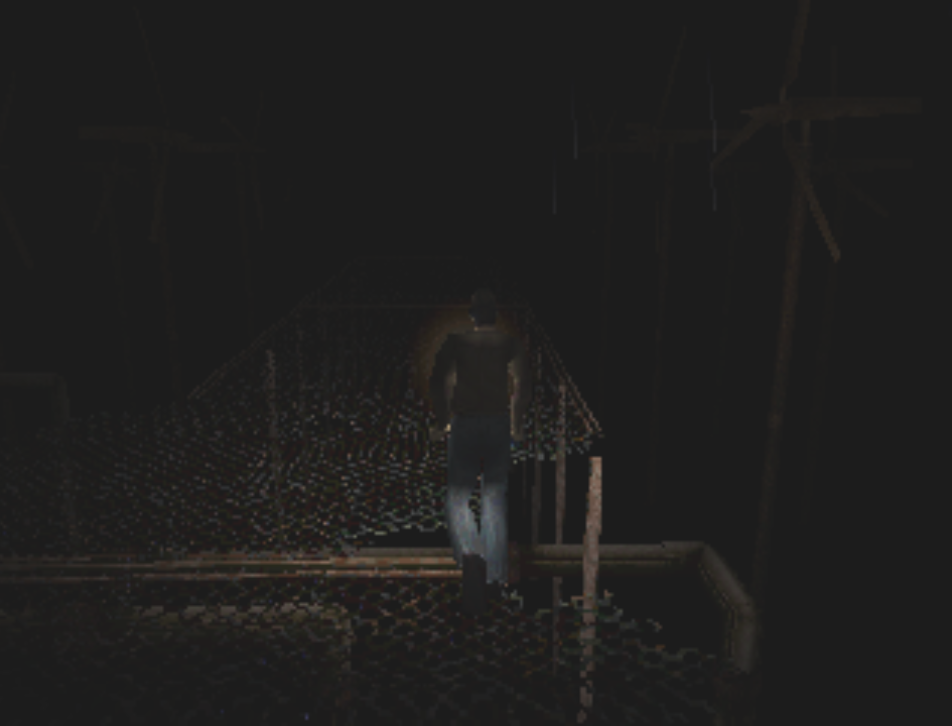
I guess the funny thing is that, despite how interesting I find it as an interactive experience, I don't know if I'd call it "scary". Despite the fact that my own personal darkness was capable of reflecting in there - there was a lot of weight and heft surrounding me, but not much pushing against me. I could imagine that being some sort of disappointment or dealbreaker, but I can't say it actually aligns far from my general relationship with the genre. Horror has become a bit of a comfort food for me - allowing myself to think about macabre subject matter from behind a window looking in. That distance essentially allows me to think about it with myself far removed, allowing for the process to be meditative rather than stressful. And maybe, just maybe, I have become a bit of a freak for it - one that genuinely enjoys myself during and everything described as "oppressive atmosphere" (or maybe i just fw the annoying puzzles too much). It wouldn't matter if none of what I loved about my time with it was present, cuz shit is an aesthetic gem. I'd love Silent Hill if the only scene in the whole thing was that alleyway with the wild camera angles in the first hour. It has a good balance between stress, and soothing art museum trekking. And that screeching siren that plays each time you kill a boss - as if the deeper you go, the closer you get to breaching True Reality? Fire as fuck. Akira Yamaoka was inspired by Nine Inch Nails, but Reznor's music was still Fun.
For a story about a father looking in on the darkness in another, darker person he didn't previously understand; I think it's cool that we can explore the light in an elsewhere's darkness, and find something of value in it.